
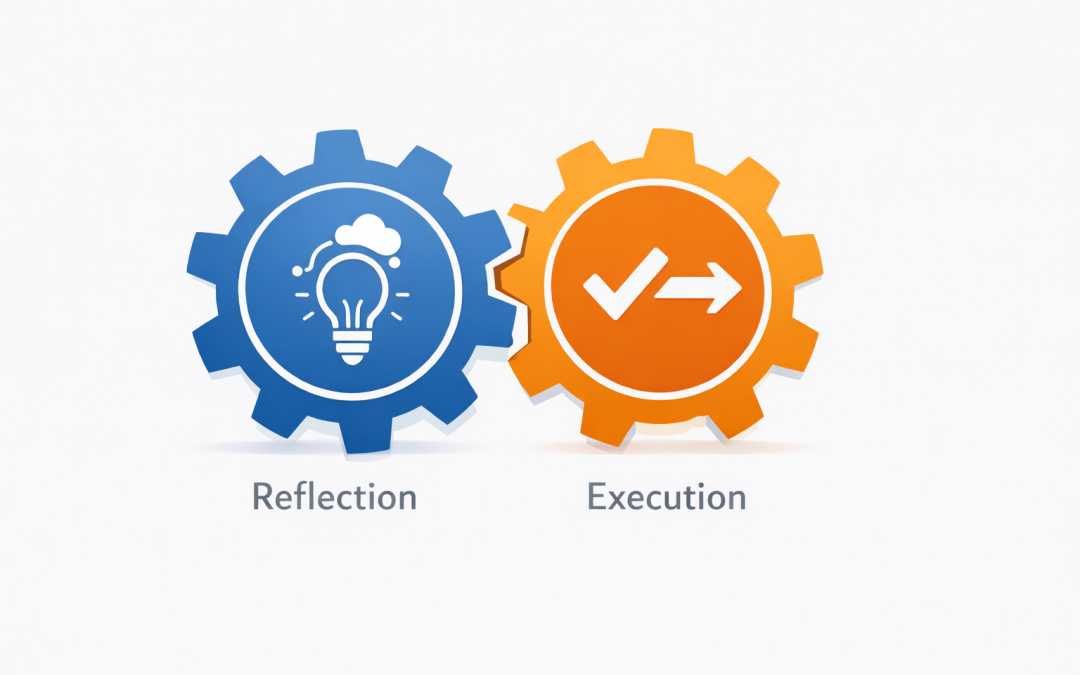
I was designing my monthly business reflection system when I hit a wall.
The system itself was simple. Track outreach numbers. Review what worked. Identify one thing to change next month. Nothing complicated.
But as I mapped it out, a familiar tension surfaced.
“Do I spend my limited time analyzing or executing?”
The question felt reasonable. I’d just started posting daily and doing consistent outreach that week. I knew these activities mattered – I just hadn’t been executing on them consistently. Momentum was building.
Why would I add another layer of reflection when what I actually needed was more execution?
The False Choice We All Make
I’d created a false binary.
Analysis or execution. Reflection or action. Strategy or doing.
As if they were opposites. As if choosing one meant abandoning the other.
The moment I recognized the trap, something else became clear.
I already had proof this wasn’t an either/or choice.
My daily reflection takes 20 minutes. I do it every day. It helps me process my experiences, generate content ideas, and notice patterns in my behavior.
I’ve never once thought of those 20 minutes as “time away from execution.”
So why was I suddenly treating a 30-minute weekly business review as if it would derail my momentum?
What Reflection Actually Costs You
The fear behind the false choice is real.
We’ve all seen it. The person who plans endlessly but never ships. The entrepreneur with seventeen business models mapped out in spreadsheets but zero clients. The creator who spends months “getting clear on their message” while their competitors are already in the market.
Analysis paralysis is real. Strategic planning can absolutely become productive procrastination.
While staring at my reflection system design, something clicked.
The problem isn’t reflection itself. The problem is reflection that doesn’t lead anywhere.
When reflection becomes an end in itself, it replaces execution.
When reflection serves execution, it multiplies your effectiveness.
The difference isn’t in the time spent. It’s in what you’re actually measuring and what you do with what you learn.
Reflection That Supports Execution
After I caught myself in the false binary, I redesigned my monthly business evaluation with one filter:
Does this question help me execute better next month, or does it just make me feel smart?
What survived:
Numbers first. How many outreach conversations? How many posts published? How many revenue-building activities? Actual revenue?
No analysis yet. Just facts.
Integrity check. What did I commit to doing that I actually did? What didn’t I do? Where did my time go that didn’t build the business?
Still just observation. No judgment.
What stopped me. Where did I notice resistance when doing business activities? What belief might be creating that resistance? What small experiment can I run next month to test if that belief is actually true?
This is where reflection becomes useful. Not dwelling on the resistance, but designing a specific way to challenge it.
One decision. The single thing to start, stop, or continue next month.
That’s it.
Just: What happened? Where did I hit friction? What’s one thing to adjust?
The entire monthly evaluation takes 45-60 minutes. And every minute of it points toward executing better next month.
The Trap of Forcing Integrity
There’s one more piece that matters here.
I know what happens when you try to force integrity with your commitments. I’ve done it. Promised myself I’d post every day, then beat myself up when I missed one. Committed to outreach numbers, then felt like a failure when life got in the way.
It’s not sustainable.
The work of understanding your resistance in the monthly reflection isn’t about forcing yourself to push past it. It’s about identifying what’s creating the resistance so you can design around it.
If I notice I’m hesitating to send follow-up messages, I don’t need a lecture about discipline. I need to identify what belief is making me hesitate, then run a small experiment to see if that belief is even true.
That’s how your nervous system actually learns. Not through willpower, but through new data.
What This Actually Looks Like
My complete monthly business evaluation:
Numbers:
- Total outreach conversations
- Total content published
- Total revenue-building activities
- Actual revenue
What I Learned:
- What experiments did I run this month?
- What actually happened vs what I feared would happen?
- What is my nervous system learning from this data?
Integrity Check:
- What did I commit to doing that I actually did?
- What didn’t I do?
- Where did my time go that didn’t build the business?
What Stopped Me:
- Where did I notice resistance?
- What belief might be creating that resistance?
- What’s one small experiment for next month?
One Decision:
- The single thing to start, stop, or continue next month.
That’s the entire system. Five sections, maybe fifteen questions total, 45-60 minutes once a month.
It doesn’t replace execution. It makes execution more effective.
The Real Question
The question isn’t “Should I analyze or execute?”
The real question is: “What kind of reflection actually supports my execution instead of replacing it?”
For me, that’s reflection that tracks concrete numbers instead of abstract progress, identifies specific friction points instead of general feelings, and designs small experiments instead of big commitments. One clear decision beats ten vague intentions.
Reflection without execution creates understanding but no change.
Execution without reflection repeats the same patterns while expecting different results.
The choice was never between reflection and execution.
It was always about reflection that serves execution.